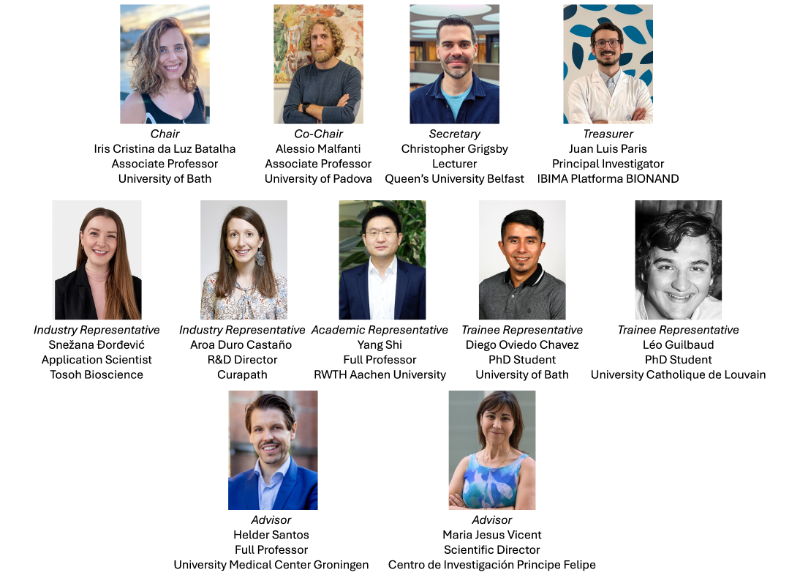
Leadership team of new Focus Group on Smart and Functional Healthcare Materials
Alessio Malfanti, an Associate Professor at the University of Padova, runs a laboratory that designs smart biomaterials for local treatment of glioblastoma and brain metastasis. More than a single formulation or therapeutic application, his laboratory is focused on material design and how the structure of a biomaterial modulates its function. At CRS Meetings, he describes the all-too-common experience of looking for other researchers in his area: “Most sessions are for a deliverable or payload or outcome, but there is no session specifically dedicated to the rational design of materials and how their features influence the therapeutic outcome.”
Iris Luz Batalha, Senior Lecturer (Associate Professor) at the University of Bath, faced a similar challenge. Her research group develops nanomedicine-based approaches for targeted drug delivery and immunomodulation across a range of applications from infection to cancer and autoimmune diseases. Drawing on this broad perspective, she recognized that many emerging materials and delivery technologies with strong translational potential remained underrepresented in broader scientific discussions. Following the success of lipid nanoparticles (LNPs), much of the conversation in drug delivery has naturally centred on these systems, leaving fewer opportunities to showcase alternative materials and chemistries that could enable the next generation of therapeutic and diagnostic breakthroughs.
Batalha and Malfanti met at the CRS Annual Meeting in 2025 and have stayed in touch ever since. When Batalha saw the call for new Focus Groups announced last year, she immediately reached out to Malfanti, knowing she wanted to create a space that highlighted material design and innovations from a chemistry perspective and that he would be the person to team up with. Malfanti was quick to accept the challenge, and they joined efforts to propose the Smart and Functional Healthcare Materials Focus Group, which officially launched at this year’s CRS Annual Meeting.
“Our vision is for a Focus Group that looks not only at the end product, the application, or the delivery route, but also at the materials science, chemistry, and synthesis strategies that make these innovations possible. LNPs have transformed the field and will undoubtedly continue to play a major role in delivery science. At the same time, there is exciting innovation taking place across many different biomaterial platforms. Our goal is to bring together researchers working with different classes of materials and delivery systems, from lipids to polymers, proteins, peptides, and other emerging approaches, so that they can learn from one another and identify common challenges and opportunities,” said Batalha. Malfanti continued, “For example, we know that changing just a small component in a formulation can completely change its pharmacokinetics and biodistribution, but the underlying design principles are not fully understood. Our Focus Group is the bridge between the materials design and the therapeutic outcome.”
Batalha and Malfanti both emphasized the importance of industry perspectives in their Focus Group. “We need to think about manufacturing and making sure our ideas are scalable,” Batalha said. Malfanti added that companies “support in the physical and chemical characterization” towards a translatable product. The industry representatives in the leadership of the new Focus Group are Snežana Đorđević, an Application Scientist at Tosoh Bioscience, and Aroa Duro Castaño, Research & Development Director at Curapath.
Another essential piece of the Focus Group is the trainee perspective. “While principal investigators often present the final product and its biological and clinical outcomes, PhD students and postdocs are typically the ones in the laboratory troubleshooting and solving the countless challenges that arise when translating an idea into a working system, and this work is mostly hidden,” commented Batalha. The Focus Group will provide opportunities for trainees to exchange ideas, discuss common challenges, build collaborations, and showcase their work while connecting with both academic and industry researchers. Two PhD students, Léo Guilbaud (Université Catholique de Louvain) and Diego Oviedo Chavez (University of Bath), will serve as trainee representatives on the leadership of the Focus Group.
The Focus Group’s leadership team also includes Christopher Grigsby (Lecturer, Queen’s University Belfast) as Secretary, Juan Luis Paris (Principal Investigator, IBIMA Plataforma BIONAND) as Treasurer, and Yang Shi (Full Professor, RWTH Aachen University) as Academic Representative. The Focus Group is additionally advised by Hélder Santos (Full Professor, University Medical Center Gronigen) and Maria Jesus Vicent (Scientific Director, Centro de Investigación Principe Felipe).
Looking ahead, the new Focus Group plans to organize a series of interactive webinars in a vodcast format exploring new approaches to material discovery, design, translation, and commercialization, while bringing together perspectives from academia, industry, and regulatory science. They will also organize a dedicated session at next year’s Annual Meeting, making it easier for researchers with shared interests to connect and engage.
Batalha and Malfanti encourage all interested researchers to join the Focus Group. “Anyone interested in understanding how the properties of a material ultimately shape its performance and impact should feel represented in this community,” said Malfanti. Batalha continued, “We are not centred on a particular therapeutic area, delivery route, or technology. Our goal is to bring together researchers working across different chemistries and material platforms. Whether the application is drug delivery, diagnostics, or regenerative medicine, we believe there is tremendous value in learning from each other’s experiences and challenges.” Both co-chairs see the Focus Group as an important way to attract new members to CRS and strengthen connections with other societies.
The new Focus Group plans to create a LinkedIn page and social media for more information and online engagement. In the meantime, interested members can directly email Batalha (icdlb20@bath.ac.uk) and Malfanti (alessio.malfanti@unipd.it).
Andrea Joseph is an Assistant Professor of Biomedical and Chemical Engineering at Syracuse University.