

The Nano3D Research Group, based at the School of Pharmacy of the Federal University of Rio Grande do Sul (UFRGS), Brazil, is led by Prof. Ruy Carlos Ruver Beck, Full Professor of Pharmaceutical Technology and current Dean of the School of Pharmacy. Prof. Beck graduated in Pharmacy and completed his MSc in Pharmaceutical Science and Technology at the Universidade Federal de Santa Maria. He obtained his PhD in Pharmaceutical Sciences from UFRGS, including a doctoral research period at Saarland University, Germany. Later, he spent a senior postdoctoral period at the UCL School of Pharmacy, United Kingdom. This trajectory helped shape the scientific foundation from which Nano3D emerged: the convergence of nanocarrier-based drug delivery, pharmaceutical materials science, and additive manufacturing.
Prof. Beck has played a pioneering role in introducing pharmaceutical 3D printing into the Brazilian drug delivery research landscape and in connecting this field with a long-standing expertise in nanocarrier-based systems. His scientific leadership is reflected in the coordination of national and international research projects and in the supervision of undergraduate, MSc, PhD, and early-career researchers. He has also led collaborative initiatives aimed at translating advanced pharmaceutical technologies into healthcare-relevant solutions.
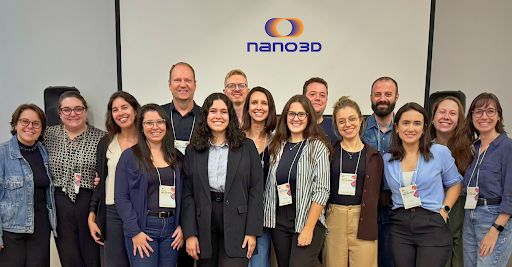
Figure 1. The Nano3D Research Group at UFRGS. A multidisciplinary team working at the interface of nanomedicine, pharmaceutical materials science, and additive manufacturing.
Within this context, the Nano3D Research Group develops drug delivery systems through complementary approaches involving nanotechnology, 3D printing, and materials science. The group does not treat these areas as isolated platforms, but as interoperable tools to address formulation, manufacturing, and biopharmaceutical challenges across different routes of administration.
A distinctive part of this portfolio is the integration of nanoscale carriers with 3D-printed dosage forms, aiming to combine the complementary strengths of nanotechnology and additive manufacturing. In this strategy, nanocarriers may improve drug solubility, drug targeting, stability, and protection against degradation, while 3D printing enables dose personalization, architectural control, and modulation of in vitro drug release. Together, these features support the development of prototypes and dosage forms with improved biological performance and/or greater alignment with patient-specific needs. The initial demonstration of this concept was achieved during his postdoctoral fellow at UCL by incorporating polymeric nanocapsules into 3D printed tablets, enabling the conversion of liquid nanosystems into solid dosage forms. This work established a first link between nanoscale carriers and macroscale design, showing that parameters such as polymer composition and internal structure could modulate both drug loading and release.
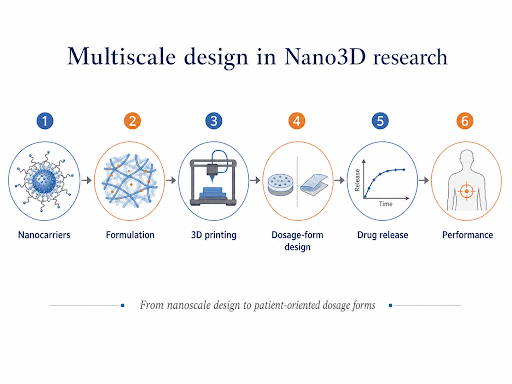
Figure 2. Multiscale design in Nano3D research. Conceptual overview of the Nano3D approach, showing how nanocarriers, formulation strategies, 3D printing, dosage-form architecture, drug release, and biological performance are connected within a multiscale drug delivery framework. The figure was created with the assistance of ChatGPT/OpenAI based on author-provided scientific content and was subsequently reviewed, edited, and approved by the authors.
Subsequent developments focused on integrating these scales at the manufacturing level. The use of semisolid extrusion (SSE) enabled the direct fabrication of redispersible nanomedicines in a single-step process, preserving the physicochemical characteristics of the nanocarriers while forming solid dosage units. This transition from sequential to integrated processing reduced formulation complexity and improved reproducibility, representing a relevant step toward application-oriented development.
More recent work has explored spatially resolved systems in which different functional layers are combined within a single structure. Multilayer films produced by SSE have been designed to enhance bioadhesion while protecting photolabile compounds, demonstrating how structural organization governs both stability and drug delivery performance. These systems provide a direct example of multiscale design, where material composition, geometry, and nanoscale interactions are interdependent.
In parallel, the group has developed 3D printing approaches independent of nanoscale systems. Studies based on fused deposition modelling (FDM) have shown that the combination of polymers with distinct physicochemical properties enables precise modulation of drug release profiles. These results highlight the role of materials engineering in additive manufacturing and demonstrate that structural design alone can be used to tailor drug delivery behaviour.
A consistent feature of the group’s work is the alignment of formulation strategies with specific administration contexts. For example, 3D printed dosage forms have been developed for administration via enteral feeding tubes, addressing limitations associated with off-label drug use in hospital settings. These systems were designed to ensure reproducible dosing, appropriate dispersion, and compatibility with clinical practice, illustrating how engineering approaches can be adapted to real-world constraints.
Complementing these developments, the group maintains active research in nanomedicine, particularly in applications requiring the overcoming of biological barriers. Intranasal delivery of ivermectin-loaded nanocarriers has demonstrated improved therapeutic outcomes in preclinical glioma models, supporting the role of nanoscale systems in enhancing drug performance.
The scientific development of these approaches is closely connected to collaborative efforts at both national and international levels. Prof. Beck is responsible for the conception and coordination of the INCT_3D-Saúde (National Institute of Science and Technology in 3D Printing and Advanced Materials for Health), which integrates multiple institutions and areas of expertise to advance the development and evaluation of drug delivery systems. This initiative provides a significant financial support by CNPq/Brazil and a coordinated framework that enables the scaling and integration of multiscale strategies across different research environments.
At the international level, the group maintains active collaborations with research teams in Germany, the United Kingdom, and Spain, reflected in joint publications and research projects focused on pharmaceutical 3D printing, nanomedicine, and advanced materials. The participation of the group’s leader in the Pharma3DPI initiative (https://pharma3dpi.org/home) further contributes to connecting Brazilian research with leading international efforts in this field.
The Nano3D Research Group is composed of a multidisciplinary team of researchers working across pharmaceutical technology, materials science, and nanomedicine. Key contributors include researchers such as Prof. Dr. Karina Paese, Prof. Dr. Monique Deon, Prof. Dr. Diego Fontana de Andrade, and Dr. Nadine Lysyk Funk, whose work supports the development of integrated drug delivery systems and the training of graduate students and early-career scientists.
The translation of these technologies toward practical applications is supported by the creation of Formula3D, a spin-off company originating from the group’s research activities. Currently embedded within the technological incubator of the Hospital de Clínicas de Porto Alegre, Formula3D operates in direct connection with a hospital environment, enabling interaction between formulation development and clinical demands. This setting provides a platform to evaluate the feasibility of implementing 3D printing for point-of-care production of personalised medicines.
The advancement of drug delivery systems toward clinical use depends on the integration of technological innovation, regulatory considerations, and healthcare implementation. In this context, approaches that combine control over nanoscale properties, material composition, and structural design offer a consistent pathway to address these challenges.
The Nano3D Research Group contributes to this effort by using different emerging strategies that connect fundamental research with application-oriented development. By integrating nanotechnology, additive manufacturing, and materials science within a coherent framework, the group advances the design of drug delivery systems that are adaptable to specific therapeutic and clinical contexts.
Top 10 Relevant Publications (2021–2026):
- DOS SANTOS, J. et al. From liquid nanocapsules to 3D-printed medicines: effect of freeze-drying on dexamethasone release and intestinal permeation. International Journal of Pharmaceutics, 2026. DOI: 10.1016/j.ijpharm.2025.126497.
- FUNK, N. L. et al. Naproxen printlets for extemporaneous dispersion: Designing new medicines for drug delivery through the enteral route. European Journal of Pharmaceutics and Biopharmaceutics, 2026. DOI: 10.1016/j.ejpb.2025.114939.
- VELHO, M. C. et al. Intranasal Delivery of Ivermectin Nanosystems as an Antitumor Agent: Focusing on Glioma Suppression. ACS Biomaterials Science & Engineering, 2025. DOI: 10.1021/acsbiomaterials.5c00642.
- LEÃO, J. et al. Pimobendan controlled release guar gum printlets: Tailoring drug doses for personalised veterinary medicines. International Journal of Pharmaceutics, 2024. DOI: 10.1016/j.ijpharm.2024.124017.
- DE OLIVEIRA, R. S. et al. Bioadhesive 3D-Printed Skin Drug Delivery Polymeric Films: From the Drug Loading in Mesoporous Silica to the Manufacturing Process. Pharmaceutics, 2023. DOI: 10.3390/pharmaceutics15010020.
- DOS SANTOS, J. et al. Poly(ε-caprolactone) and Eudragit E blends modulate the drug release profiles from FDM printlets. International Journal of Pharmaceutics, 2023. DOI: 10.1016/j.ijpharm.2023.123533.
- DE OLIVEIRA, T. V. et al. Redispersible 3D printed nanomedicines: An original application of the semisolid extrusion technique. International Journal of Pharmaceutics, 2022. DOI: 10.1016/j.ijpharm.2022.122029.
- DEON, M. et al. A critical review of traditional and advanced characterisation tools to drive formulators towards the rational development of 3D printed oral dosage forms. International Journal of Pharmaceutics, 2022. DOI: 10.1016/j.ijpharm.2022.122293.
- SANTOS, J. et al. Three-Dimensional Printing and Nanotechnology: A Multiscale Alliance in Personalised Medicine. Advanced Functional Materials, 2021. DOI: 10.1002/adfm.202009691.
- DOS SANTOS, J. et al. Eudragit®: A Versatile Family of Polymers for Hot Melt Extrusion and 3D Printing Processes in Pharmaceutics. Pharmaceutics, 2021. DOI: 10.3390/pharmaceutics13091424.
For further information about the Nano3D Research Group, please contact Prof. Ruy C. R. Beck at ruy.beck@ufrgs.bror follow the group on Instagram: https://www.instagram.com/nano3dufrgs/.
Use of AI-assisted editing: ChatGPT was used to support language revision and improve clarity and readability. The authors reviewed, edited, and approved the final text and remain fully responsible for its content